
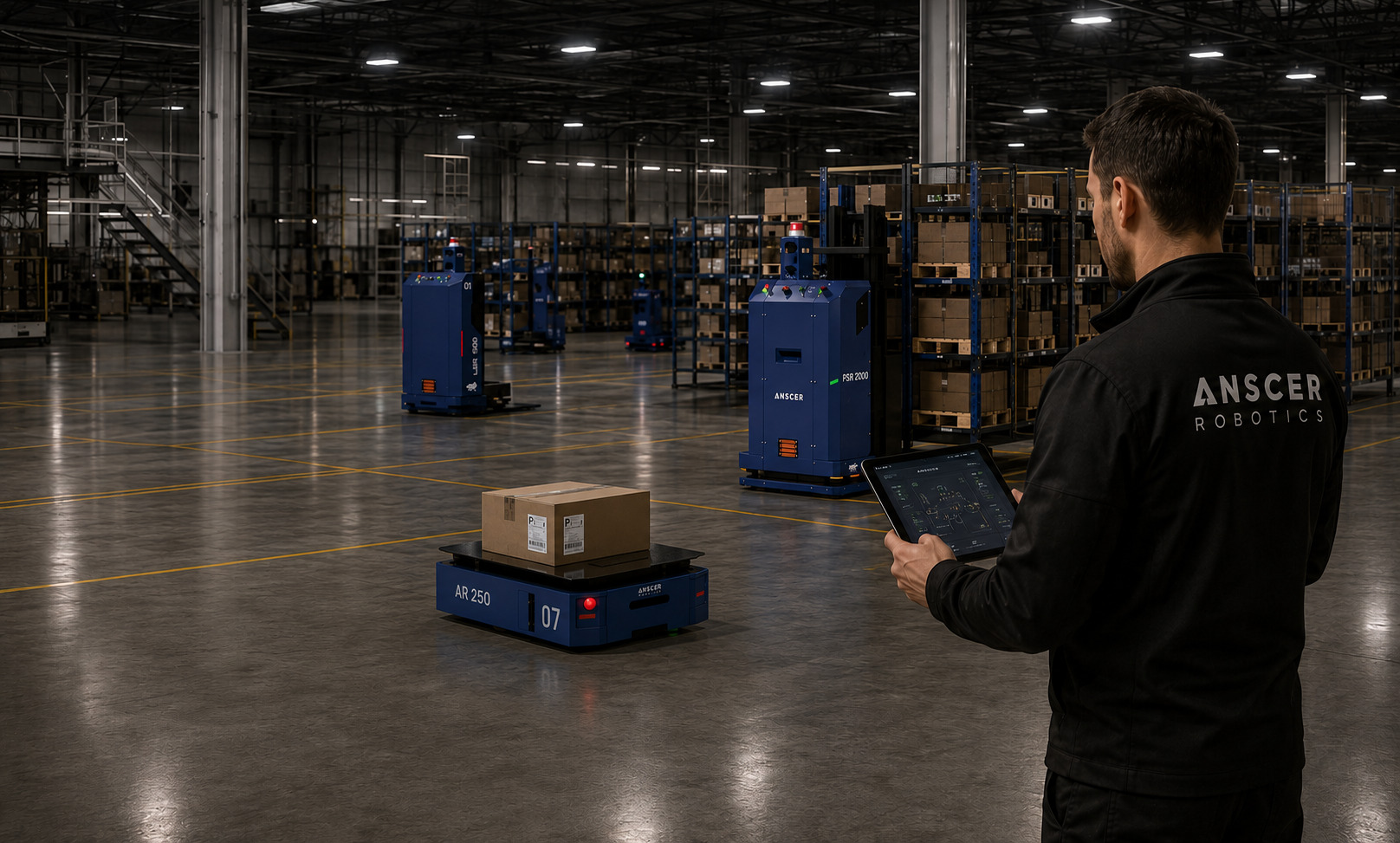
software solutions
ANSCER's software suite transforms autonomous mobile robots into synchronized, facility-wide operations — from real-time fleet control to industry-specific workflow automation.
request demo

Centralized intelligence for monitoring, controlling, and optimizing every robot operation from a single platform.
The ANSCER Fleet Management System (FMS) is the intelligent orchestration platform that coordinates, monitors, and manages the operations of multiple autonomous mobile robots (AMRs) within a facility. Acting as the central control layer for robotic operations, the ANSCER FMS enables seamless automation of material movement workflows across manufacturing plants, warehouses, and intralogistics environments.

The platform provides centralized visibility and control over robot fleets, ensuring optimized traffic flow, efficient task execution, and uninterrupted robot availability.
.svg)
The Fleet Management System coordinates individual robot activities into synchronized facility-wide operations, improving efficiency, safety, and overall productivity.
Key Capabilities

Coordinate and manage the movement of multiple robots operating simultaneously within the same environment. The ANSCER FMS intelligently controls robot traffic, optimizes routing paths, prevents congestion, and ensures safe navigation throughout the facility.
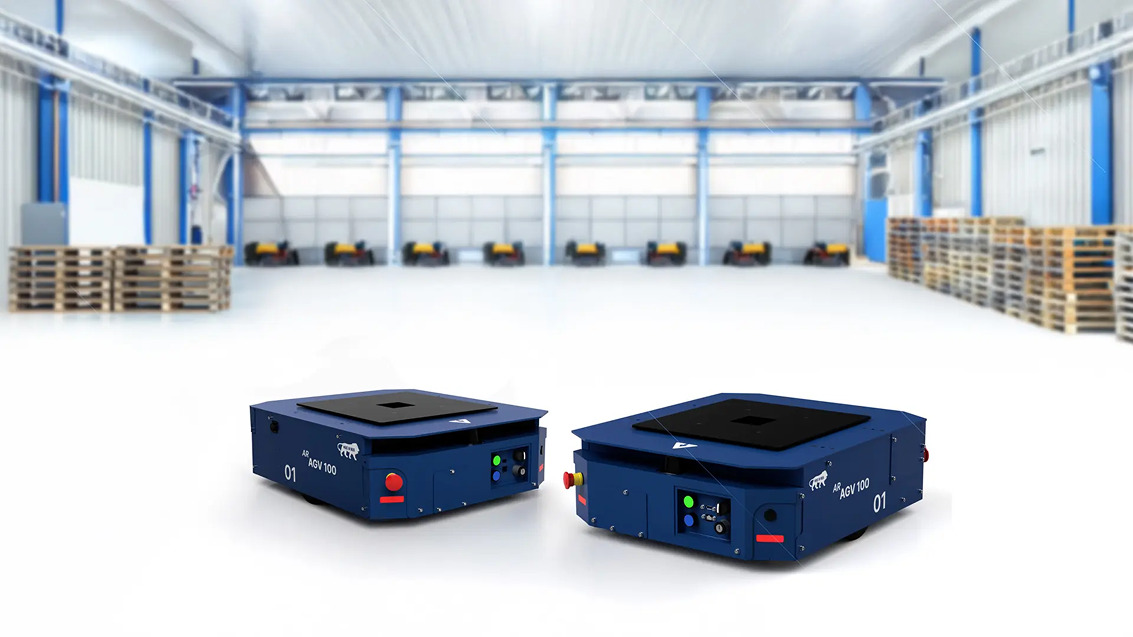
Automatically assign transport missions and operational tasks to available robots based on factors such as robot location, battery status, workload, and task priority. This ensures balanced fleet utilization and optimized operational efficiency.
Maintain continuous robot availability with automated charging management. The system monitors robot battery levels in real time and autonomously dispatches robots to charging stations when required, minimizing downtime and maximizing operational uptime.
Configure, schedule, and monitor robot missions through a centralized management interface. Users can create transport workflows, assign priorities, and track mission execution across the entire fleet.
Manage robot operations autonomously across production lines, warehouses, staging zones, and logistics areas. The FMS coordinates robot activities to ensure smooth material flow and uninterrupted operations.
Gain complete visibility into fleet performance through live dashboards and operational monitoring tools. Track robot status, mission progress, traffic flow, and system health in real time.
Access the ANSCER FMS through a modern browser-based interface without requiring specialized software installation. The platform is compatible with Google Chrome, Mozilla Firefox, Microsoft Edge, Apple Safari
BENEFITS
From tugging and lifting to robotic arm integration and conveyor automation, our AMRs are designed to streamline operations, enhance safety, and maximize efficiency.
Manage multiple robots and workflows from a single unified platform.
Easily expand robot fleets and operational workflows as facility requirements grow.
Automated charging management and intelligent task scheduling help maintain continuous robot availability.
Controlled robot traffic flow reduces congestion and improves operational safety within shared environments.
The intuitive web-based interface simplifies fleet management for operators and supervisors without re..
Optimize robot utilization and availability through automated opportunistic charging and intelligent task scheduling.


Transform operational workflows into structured, automated processes that seamlessly integrate with robotic operations.
The ANSCER Business Application sits above the Fleet Management System, transforming industry-specific operational requirements into executable robotic workflows. By adapting robot capabilities into complete business processes, it enables teams across electronics, automotive, textile, warehousing, and pharmaceutical industries to automate operations without complex engineering.
Supported Industries
Electrical & Electronics
Automotive
Textile
Warehousing & 3PL
Pharmaceuticals
Key Capabilities

Configure and manage operational workflows with ease. The platform translates business processes into structured robotic task sequences
Adapt workflows to meet the operational requirements of industries including Electrical & Electronics, Automotive, Textile, Warehousing & 3PL, and Pharmaceuticals.
Simplify automation for operators with user-friendly interfaces, calling stations, dashboards, and APIs that enable single-click task execution without requiring technical expertise.
Convert high-level operational commands into executable robotic actions, including navigation, routing, material handling, load transfers, and workflow-driven task execution.
Configure and manage operational workflows with ease. The platform translates business processes into structured robotic task sequences
Adapt workflows to meet the operational requirements of industries including Electrical & Electronics, Automotive, Textile, Warehousing & 3PL, and Pharmaceuticals.
Simplify automation for operators with user-friendly interfaces, calling stations, dashboards, and APIs that enable single-click task execution without requiring technical expertise.
Convert high-level operational commands into executable robotic actions, including navigation, routing, material handling, load transfers, and workflow-driven task execution.
Benefits

Separates business logic from robot control logic
.svg)
Supports multi-industry deployments
Multiple implementation approaches (prebuilt, low-code, integrated)
.svg)
Minimizes need for custom coding

Simplifies interaction for non-technical operators
Build, configure, and modify robot workflows using a visual drag-and-drop interface without writing code.
The Process Flow Manager enables users to create, configure, and modify operational workflows for different business use cases within a facility. Designed for industries such as electrical & electronics, textiles, industrial automation, warehousing, and 3PL, the platform helps standardize and automate repetitive material handling operations across facilities.
Key Features
Drag & Drop Configuration
No-Code Logic Design
Visual Workflow Builder
Multi-Robot Coordination
WORKFLOW CONFIGURATION
The Process Flow Manager enables users to create robotic workflows through a drag-and-drop, block-based interface, allowing teams to automate processes without complex programming.
Navigate the robot between locations.
Execute material pickup operations.
Pause operations based on process conditions or timing requirements.
Perform material delivery or unloading actions.
Benefits
Create and modify process flows quickly to adapt to changing operational requirements.
.svg)
Support diverse material handling workflows across manufacturing, warehousing, and logistics environments.
.svg)
Transform complex operational activities into easy-to-manage robotic workflows.
Standardize and replicate workflows across multiple plants, production lines, or facilities.
Minimize manual coordination and improve process consistency through automated task execution.
Turn Operational Data Into Actionable Intelligence
The ANSCER Analytics Platform provides comprehensive operational insights into robot fleets, missions, and facility workflows. Designed to support data-driven decision-making, the Analytics layer transforms real-time operational data into actionable intelligence that helps optimize robot performance, improve workflow efficiency, and enhance overall facility productivity.
By continuously collecting and analyzing data from robot operations, mission requests, traffic flow, and system events, the platform enables users to monitor key performance indicators, identify operational bottlenecks, and proactively improve automation performance across facilities.
Key Capabilities
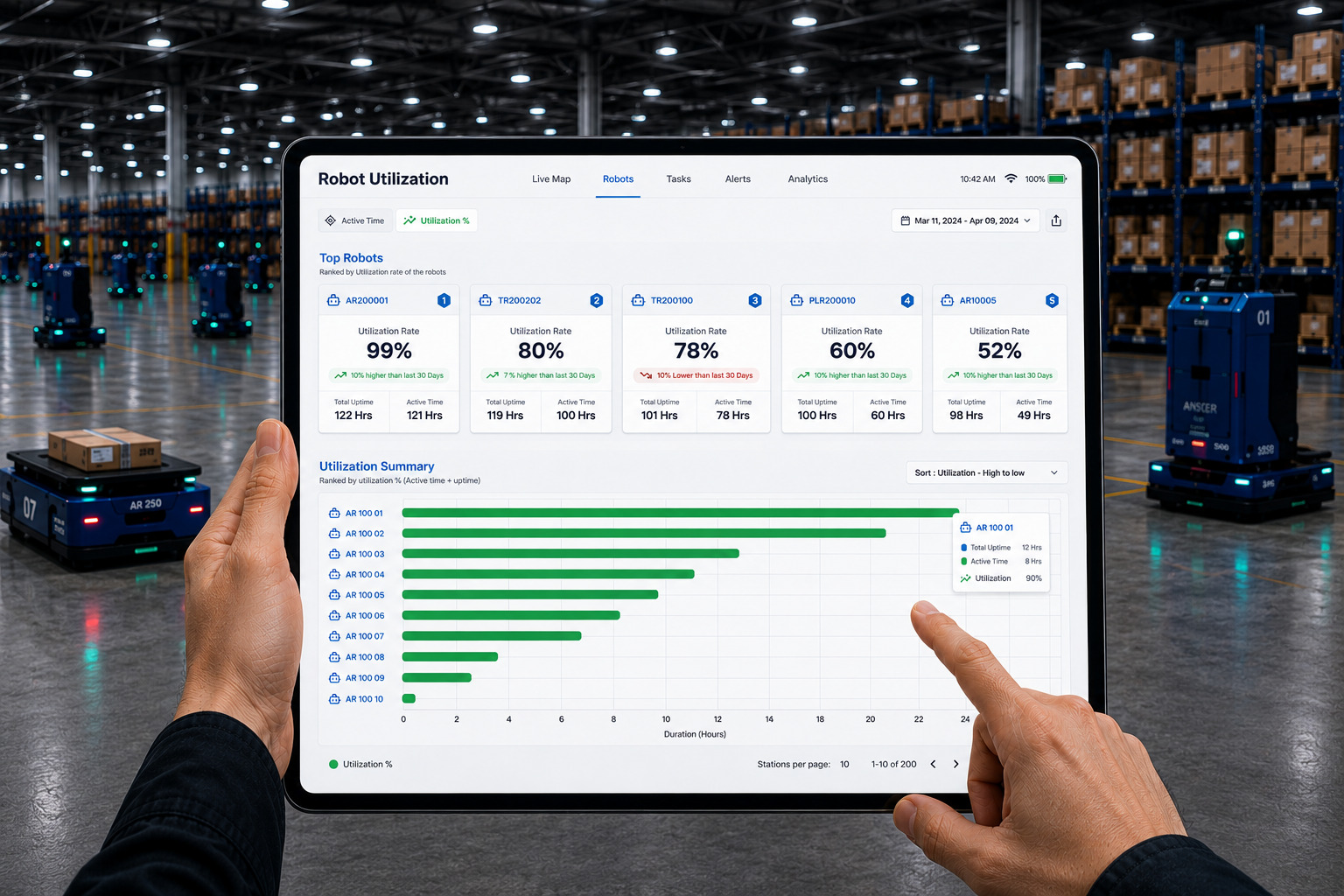
Monitor robot activity, operational efficiency, and fleet performance through detailed utilization reports. The platform provides visibility into robot active time, idle time, mission execution, and utilization rates to help maximize fleet productivity.
Access centralized dashboards that display critical operational metrics and performance indicators in real time.
Key analytics include:
Request success rate
Mission volume
Robot utilization rate
Active stations and stores
Fleet performance trends
Operational efficiency metrics
Analyze all mission and transport requests generated across stations, production areas, and storage locations.
The Request Overiew module provides detailed
insights into:
Total request volume
Completed and failed requests
Success rates
High-demand stations and stores
Workflow activity trends
This data enables operators to identify operational patterns and optimize material flow processes.
Visualize operational incidents and traffic patterns across facility maps using intelligent heatmap analytics. The Heatmap module helps identify high-activity and high-risk areas within the facility by displaying:
Total request volume
Completed and failed requests
Success rates
High-demand stations and stores
Workflow activity trends
Receive proactive notifications and predictive alerts related to robot performance, traffic congestion, operational anomalies, and potential system issues. Predictive insights help reduce downtime and improve operational continuity.
Filter analytics and operational reports based on custom date ranges, robots, locations, missions, or event types to support detailed performance analysis and reporting.


Monitor robot activity, operational efficiency, and fleet performance through detailed utilization reports. The platform provides visibility into robot active time, idle time, mission execution, and utilization rates to help maximize fleet productivity.
Access centralized dashboards that display critical operational metrics and performance indicators in real time.
Key analytics include:
Request success rate
Mission volume
Robot utilization rate
Active stations and stores
Fleet performance trends
Operational efficiency metrics
Analyze all mission and transport requests generated across stations, production areas, and storage locations.
The Request Overview module provides detailed insights into:
Total request volume
Completed and failed requests
Success rates
High-demand stations and stores
Workflow activity trends
This data enables operators to identify operational patterns and optimize material flow processes.
Visualize operational incidents and traffic patterns across facility maps using intelligent heatmap analytics. The Heatmap module helps identify high-activity and high-risk areas within the facility by displaying:
Emergency stop locations
Robot errors
Traffic congestion zones
Connection interruptions
Navigation bottlenecks
Receive proactive notifications and predictive alerts related to robot performance, traffic congestion, operational anomalies, and potential system issues. Predictive insights help reduce downtime and improve operational continuity.
Filter analytics and operational reports based on custom date ranges, robots, locations, missions, or event types to support detailed performance analysis and reporting.
benefits
Improved Operational Visibility
Gain real-time and historical insights into robot operations, fleet performance, and workflow efficiency.
Data-Driven Optimization
Use operational analytics to identify bottlenecks, improve traffic flow, and optimize robot utilization.
Increased Fleet Efficiency
Monitor utilization rates and mission trends to maximize robot productivity and reduce idle time.
Faster Issue Identification
Heatmaps and predictive alerts help quickly detect operational issues, congestion areas, and recurring system events.
Enhanced Decision Making
KPI dashboards and analytics reports support informed operational planning and continuous process improvement.
Scalable Performance Monitoring
Analyze and manage performance across single or multi-site robotic deployments from a centralized platform.
Continuous Improvement
Leverage historical operational data to refine workflows, improve system reliability, and enhance overall automation performance.
Improved Operational Visibility
Gain real-time and historical insights into robot operations, fleet performance, and workflow efficiency.
Data-Driven Optimization
Use operational analytics to identify bottlenecks, improve traffic flow, and optimize robot utilization.
Increased Fleet Efficiency
Monitor utilization rates and mission trends to maximize robot productivity and reduce idle time.
Faster Issue Identification
Heatmaps and predictive alerts help quickly detect operational issues, congestion areas, and recurring system events.
Enhanced Decision Making
KPI dashboards and analytics reports support informed operational planning and continuous process improvement.
Scalable Performance Monitoring
Analyze and manage performance across single or multi-site robotic deployments from a centralized platform.
Continuous Improvement
Leverage historical operational data to refine workflows, improve system reliability, and enhance overall automation performance.

Book your demo now—watch ANSCER take total control, instantly.


28B, 4th Main, Industrial Area, Bommasandra, Bengaluru, Karnataka 560099
Phone: (+91) 9739499716
3571 Far West Blvd, #3692 Austin,
TX 78731-3064,
Phone: (+1) 971-431-8811
© ANSCER Robotics 2026 | All rights reserved
